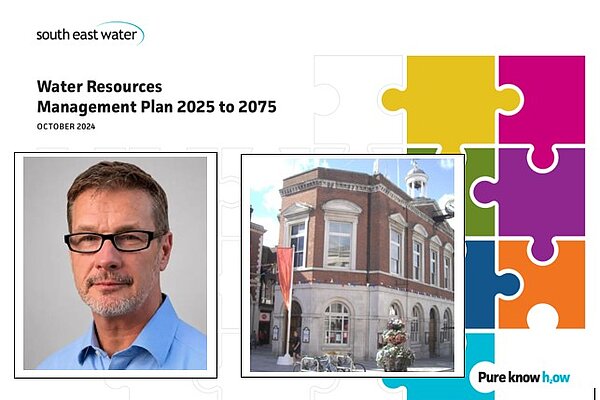
Maidstone Council Leaders Hold "Productive" Talks with South East Water CEO on Supply and Planning Reform
Senior figures at Maidstone Borough Council have held high-level talks with the chief executive of South East Water, focusing on infrastructure investment, spatial planning and the future of water resources across the Borough.
Cllr Tony Harwood, Cabinet Member for Planning Policy and Management at Maidstone Borough Council, met with John Halsall, CEO of South East Water, on Wednesday 29th July, alongside Cllr Stuart Jeffery, Leader of the Council, and William Cornall, Director of Regeneration and Place.
Describing the meeting, Cllr Harwood said:
"Stuart Jeffery (Leader of Council), William Cornall (Director of Regeneration and Place) and I held a very positive, business-like and productive meeting with John Halsall, CEO at South East Water, on Wednesday 29th July.
Topics covered included the potential for closer working and making common cause on lobbying the Government, Environment Agency and regulators for sensible water policy reforms.
Spatial planning matters were also a key focus of discussion, encompassing scale and locations of development allocations, rollout of water conserving technology across new and existing developments, and potential for new land use rules within aquifer protection zones, to facilitate improved groundwater recharge.
Targeted investment in infrastructure to tackle low pressure and supply disruption challenges across parts of the network were also covered, with specific reference to those areas of the Borough that are particularly vulnerable including Loose, Coxheath, Linton, Harrietsham, Ulcombe, Staplehurst and Headcorn.
The use of treated drinking quality water for agriculture, horticulture, street cleaning and other purposes was also covered, with the potential for local pilot initiatives to support construction of new farm irrigation reservoirs, infrastructure to support 'grey water' re-use.
At the conclusion of the meeting John Halsall specifically requested a further meeting in the near future to review progress against the commitments made. The constructive nature and shared vision that emerged from this dialogue bodes well for better local planning and decision making over precious water resources in this overcrowded and drought stressed corner of the country."
Vulnerable areas identified
Among the issues discussed was targeted investment to address low water pressure and supply disruption, with particular reference to parts of the Borough that experience ongoing challenges, including Loose, Coxheath, Linton, Harrietsham, Ulcombe, Staplehurst and Headcorn.
Planning and water policy
The discussion also touched on the interaction between spatial planning and water resources, including the scale and location of future development allocations, wider rollout of water-conserving technology in new and existing homes, and possible new land use rules within aquifer protection zones to support groundwater recharge.
Alternative uses for treated drinking-quality water were also raised, including agriculture, horticulture and street cleaning, with scope for local pilot schemes to support new farm irrigation reservoirs and grey water re-use infrastructure.
Next steps
John Halsall is reported to have asked for a follow-up meeting to review progress against the commitments made during the discussion. Cllr Harwood said the constructive nature of the meeting bodes well for improved local planning and decision-making over water resources in what he described as an overcrowded and drought-stressed part of the country.